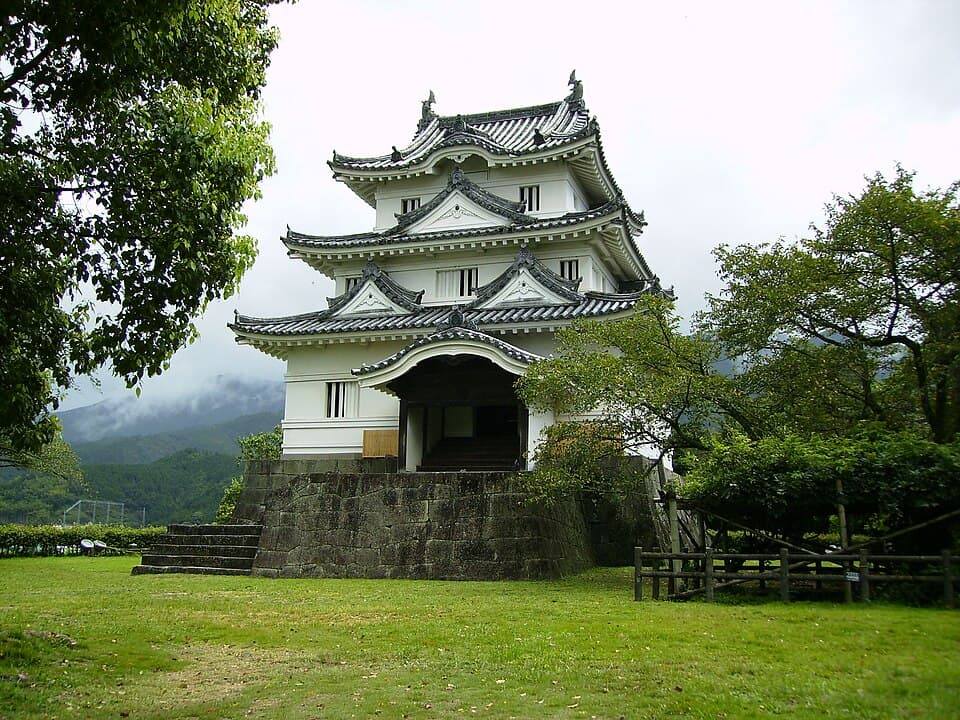
Uwajima Castle
One of Japan's twelve remaining original castle keeps, built by Tōdō Takatora, a master castle architect, and served as the grand residence of the Date clan with 100,000 koku. A graceful three-story tower keep with white plastered walls remains atop a small hill, and it is designated as an Important Cultural Property as a precious example of early Edo period castle architecture.
Uwajima Castle is a precious early modern castle located in the center of Uwajima City, Ehime Prefecture, and is counted among Japan's twelve remaining original castle keeps. It was constructed in Keicho 1 (1596) by Tōdō Takatora, a renowned master castle builder, on the site of the former Itajima-Marugushi Castle overlooking the sea. Originally, there had been a coastal fortress here since medieval times, valued as a strategic point for maritime transport on Uwa Bay. Takatora undertook large-scale renovations to transform it into a modern castle and created a distinctive irregular pentagonal fortification plan that skillfully incorporated the coastline. This fortification, which appears quadrilateral from the outside, is considered Takatora's clever stratagem to deceive enemies, and it is highly regarded as a masterpiece representing the pinnacle of castle construction.
The current three-story tower keep does not date to the Takatora era, but was rebuilt by the second domain lord, Date Munetoshi, around Kanpun 6 (1666). With its elegant white-plastered exterior, regularly arranged roof gables, and the rhythmic composition of chidori-gables and karahafu (decorative gables), it represents not the austere castle architecture of the late Warring States period, but the peaceful aesthetic of the post-conflict era. The interior preserves original wooden stairs, pillars, and beams, allowing visitors to directly experience the precision craftsmanship of Edo period artisans. From the uppermost floor, one can see sweeping views of Uwa Bay, Uwajima's cityscape, and even the mountain ranges of Kyushu on clear days, offering a panoramic vista of the stage of history where the Date clan, though a smaller domain of 100,000 koku, guarded this important maritime gateway.
After the Battle of Sekigahara, Tōdō Takatora was transferred to Imabari. Subsequently, Iwajima Hidemuné, the eldest son of Sendai Domain lord Date Masamune, was invested with 100,000 koku at this location. The Date clan's Uwajima domain continued until the Meiji Restoration. While many associate Date clan castles with Sendai Castle, Uwajima Castle was equally important as an independent Date clan stronghold. The eighth domain lord, Date Muneoki, was counted among the four wise lords of the late Edo period and was known as a progressive domain for patronizing Takano Chōei, who studied under Philipp von Siebold. Numerous cultural properties and historical sites related to the Date clan remain in the castle town, and the Tensha-en, a daimyo garden, is designated as a National Scenic Beauty—a stroll garden with pond and waterway built by Muneoki after his retirement.
Uwajima Castle's attractions extend beyond the tower keep. The stone walls leading to the main courtyard showcase construction techniques from different periods, displaying a mix of ancient nozura-zumi (rough-stacked) masonry through to refined dressed-stone fitting—a perfect learning opportunity for castle enthusiasts. The upper gate at the main entrance, an exceptionally rare yakui-mon (apothecary gate) that may date to the Takatora era, is itself designated as an Important Cultural Property. The entire castle hill is developed as a nature-rich park. In spring, approximately 300 cherry trees blossom magnificently, while autumn brings crimson foliage gracing the stone walls, offering beauty in each season. Walking the trails around the castle, one can glimpse the tower keep framed by trees against Uwa Bay, providing the luxurious experience of combining historical exploration with nature appreciation.
Among the twelve remaining original keeps, Uwajima Castle, though modest in scale, stands out for its architectural completeness and historical significance. As a port castle facing the sea, it possesses a unique charm distinct from inland mountain castles or lowland castles. Uwajima is also known for pearl cultivation and regional cuisine such as sea bream rice and jaco tempura. It is a notable destination worth incorporating into Shikoku pilgrimage routes or Shikoku tours, offering the pleasure of combining historical exploration with local gastronomy.
Access
Approximately 25 minutes on foot from Uwajima Station (JR Yosan Line), or by bus from Uwajima Station to Nanyo Cultural Center (Nanyo Bunka Kaikan-mae) bus stop, then approximately 5 minutes on foot
Hours
天守 9:00〜17:00(11〜2月は16:00まで、城山は終日開放)
Budget
天守入場 大人¥200
RELATED SPOTS
Related Spots(3 spots)


