Irozaki
A cape jutting out from the southern tip of the Izu Peninsula, featuring dramatic sea cliffs carved by the rough waves of the Pacific Ocean. The striking contrast between the dynamic wave-eroded cliffs and the deep blue sea is breathtaking, and from Ishimuro Shrine at the cape's tip and the white Irozaki Lighthouse, you can see an expansive ocean stretching to the horizon.
Irozaki is a cape at the southernmost tip of the Izu Peninsula, located in Minami-Izu Town, Kamo District, Shizuoka Prefecture. It represents a premier scenic spot of the Izu Geopark, where the dynamic wave-eroded cliffs carved by the Pacific Ocean's powerful waves over tens of millions of years meet the deep blue sea. The entire cape is composed of lava and pyroclastic rocks formed by the Izu Peninsula's volcanic activity, and its hard bedrock has withstood the intense erosion of the Kuroshio Current, creating a uniquely complex coastline. The sheer cliffs reach heights exceeding 50 meters, and their vertiginous scale rivals any cape in the Kanto region. On clear days, the silhouettes of the Izu Seven Islands appear on the distant horizon, creating a dramatic landscape worthy of being the grand finale to a journey through the Izu Peninsula.
At the cape's tip stands the beautiful white Irozaki Lighthouse, which has guided maritime traffic through the Kumano and Enshu channels for over 150 years since its first illumination in 1871. The original lighthouse was designed by British engineer Richard Henry Brunton, a historical landmark marking the dawn of Japan's modern lighthouse era, though it was damaged in the Great Kanto Earthquake. The current lighthouse is the second generation, a concrete structure rebuilt in 1933, standing approximately 11 meters tall. Though not especially large, its location at the cape's tip gives it an unmistakable presence that leaves a lasting impression on all who see it.
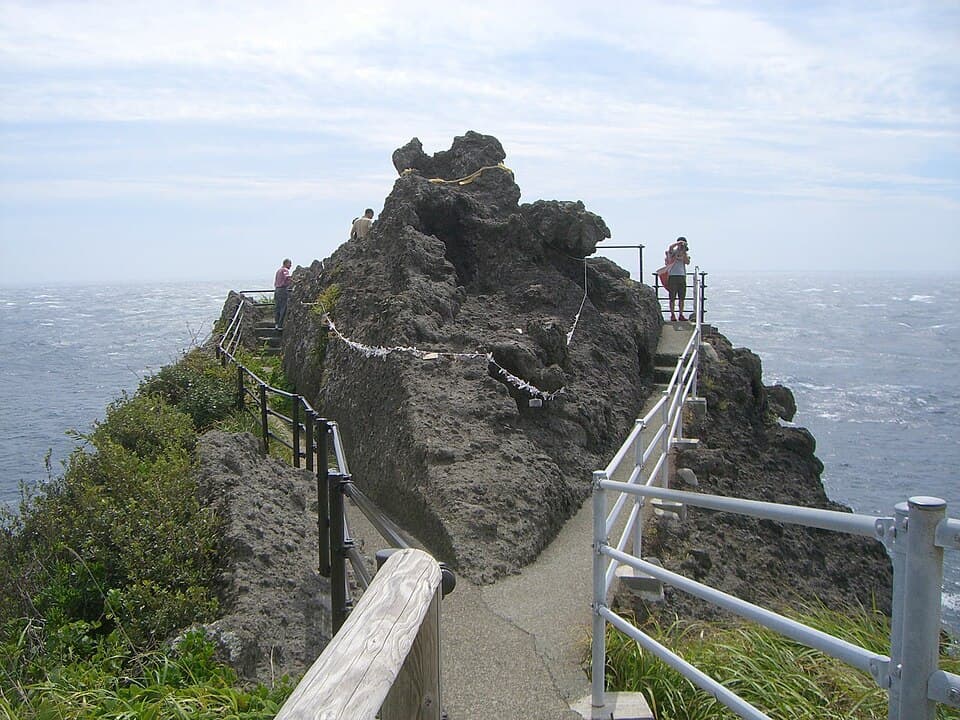
Further along the cape, clinging to the cliff face, sits Ishimuro Shrine, a structure of significance comparable to a National Important Cultural Property. This shrine ranks among the Seven Mysteries of Izu, and its sanctum cleverly incorporates the natural rock formations of the sheer cliff face—a sight that seems to embody the faith of seafaring people in tangible form. According to tradition, the shrine's floorboards were donated from the mast of a sailing ship bound for Izu Oshima, bestowed by divine revelation, and the shrine has long been revered as a deity protecting maritime safety and facilitating romantic bonds. A small shrine to Kumano is enshrined at the furthest point, establishing this location's reputation as a power spot for romantic fulfillment.
The Irozaki area is recognized as the core zone of the Izu Peninsula Geopark and holds international geological significance, where you can observe pillow lava and tuff layers formed by submarine volcanic activity some 20 million years ago, along with sea caves and unusual rock formations created by prolonged wave erosion. Boarding the Irozaki Sightseeing Boat below the cliffs allows you to observe blue grottos and formations like Minokake Rock and the Yūsuge Park cliffs from a perspective only visible from the sea, experiencing Irozaki's dynamism in a way impossible from land. Particularly in the blue grotto, when weather and sun angle align perfectly, light filtering through the sea surface bathes the cave in a mystical blue, creating a scene reminiscent of Capri Island in the Mediterranean.
The surrounding area is naturally inhabited by subtropical plant species unique to Izu's southernmost location. In early summer, clusters of Yūsuge plants display their yellow flowers against the ocean backdrop, beloved by many hikers as "Yūsuge Park." Around Irozaki Harbor, restaurants serving fresh local fish and souvenir shops line the area, offering distinctive southern Izu cuisine such as tokoro-ten made from Izu tengusa seaweed, simmered golden-eye snapper, and dishes prepared with squid ink. A journey to Irozaki offers a rich and profound experience where you can simultaneously savor the dynamism of the Izu Peninsula's nature, the faith of its people, and the maritime history of modern Japan.
Access
About 40 minutes by Tokai Bus from Izu-Kyuko Shimoda Station to Irozaki Ocean Park, then approximately 15 minutes on foot
Hours
見学自由(石廊崎遊覧船は9:30〜15:30頃)
Budget
石廊崎遊覧船 大人約¥1,500
RELATED SPOTS
Related Spots(3 spots)


